What is Zenker's diverticulum ?
Zenker's diverticulum is an uncommon yet important throat condition that every adult experiencing persistent swallowing trouble should know about. In simple terms, it is a pouch that develops in the upper part of the oesophagus, just behind the voice box, and can trap food or saliva. In this guide, we explain Zenker's diverticulum in simple terms, outline why it occurs and who is most at risk, review common symptoms and the causes, discuss when to see an ENT doctor, clarify how it is diagnosed, and outline the treatment options available at our ENT clinic in Dubai. By the end, you will recognise red-flag signs and understand when to book a consultation with an ENT specialist in Dubai.
Explain Zenker's diverticulum in simple terms
Think of the upper oesophagus as a flexible tube. When its back wall weakens, internal pressure during swallowing can force that lining to balloon outward, forming a sac. Food, pills, and mucus enter the sac instead of sliding straight to the stomach. Over time the pouch enlarges and causes troublesome symptoms. Doctors classify this as a pharyngoesophageal diverticulum, named after Dr. Friedrich Zenker, who first described it in 1877.
Why it occurs and who is most at risk
Researchers have identified two main contributors:
- Age-related muscle changes: After 60 years, the cricopharyngeus muscle (the upper oesophageal sphincter) can lose elasticity and fail to relax completely.
- Structural weakness: A natural gap called Killian’s triangle lies between throat muscles. Excess pressure during swallowing pushes tissue through this area, producing Zenker's diverticulum.
Because both factors are gradual. Seniors, especially men develop the pouch more often. Chronic coughing, gastro-oesophageal reflux disease, and neuromuscular disorders that disrupt coordinated swallowing also raise risk. A recent study estimated an incidence of 2 per 100,000 annually, with peak diagnosis in the seventh decade of life.
Common symptoms and the causes
The pouch itself does not hurt; the trapped contents do the damage. Classic complaints include:
- Intermittent difficulty swallowing solids then eventually liquids
- “Wet” gurgling noise in the neck after eating
- Regurgitation of undigested food hours later, sometimes during sleep
- Bad breath despite good oral hygiene
- Chronic cough, choking spells, or recurrent pneumonia from food aspiration
- Unintentional weight loss in advanced cases
If these common symptoms and the causes sound familiar, arrange a same-week review with an Ear nose and throat doctor to prevent complications.

When to see an ENT doctor
People often dismiss mild swallowing issues as ageing. However research recommend specialist evaluation when any of the following occur:
- Symptoms last longer than two weeks
- Night-time coughing or aspiration episodes
- Unexplained weight loss
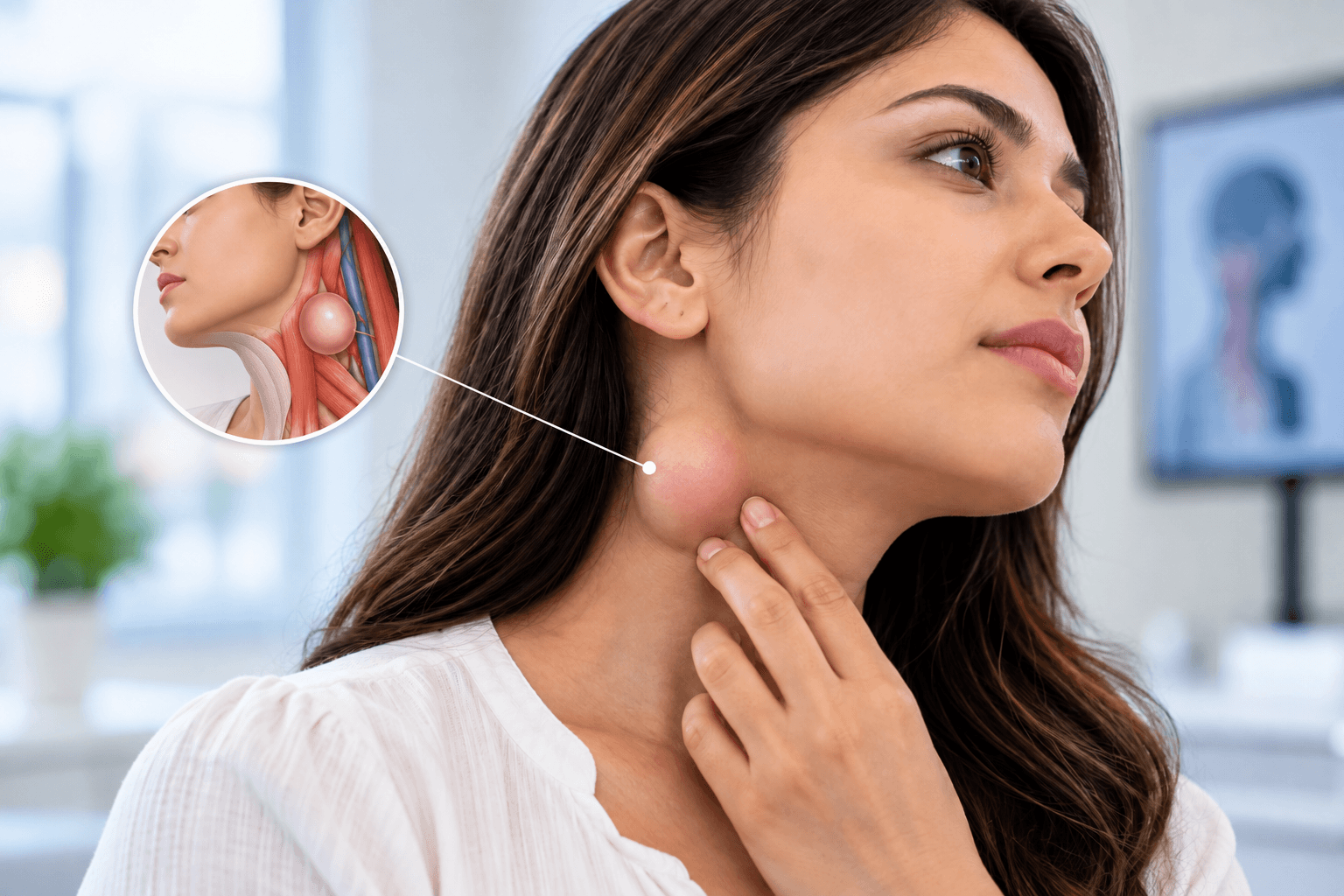
- Visible swelling on the left side of the neck
- Previous episodes of aspiration pneumonia
Visiting the Best ENT clinic in Dubai early enables safer, less invasive treatment. Our Head and Neck Doctors in Dubai also rule out mimicking conditions such as throat tumours.
How it is diagnosed
Accurate identification begins with a focused history and neck examination. Definitive tools include:
- Barium swallow X-ray: The patient drinks contrast liquid while radiographs capture the pouch outline. Sensitivity exceeds 90 %.
- Flexible nasoendoscopy: A thin camera inserted through the nose lets the ENT directly visualise pooling secretions above the vocal cords.
- CT scan: Ordered when malignancy is suspected or surgery is being planned.
These studies allow surgeons at our Best ENT Surgeon in Dubai service to map pouch size and relation to vital structures.
Treatment options available
Modern care is highly successful and tailored to pouch size, patient fitness, and equipment availability.
Endoscopic stapling diverticulotomy
During a trans-oral procedure, the surgeon introduces a diverticuloscope that exposes the party wall between the pouch and oesophagus. A stapling device divides this wall, uniting the pouch with a food channel so residue can no longer collect. Patients typically eat soft food within 24 hrs and go home the next day.
Flexible endoscopic septotomy
Gastroenterologists or ENT surgeons use a flexible scope to cut the septum with a thermal knife and seal edges with clips. This suits high-risk patients unable to tolerate general anaesthesia.
Open surgical excision
For giant sacs (>5 cm) or after failed endoscopy, a small neck incision allows complete pouch removal and cricopharyngeus muscle division. Although recovery is longer, cure rates approach 95 %.
Adjunct care
Speech and swallowing therapy at our in-house team helps retrain safe techniques. Regular follow-up imaging ensures the pouch does not reform. If reflux contributes, our allergy and sinus treatment unit manages LPRD to protect the repair.
Living well after treatment
Most patients regain normal eating confidence within weeks. Key tips include:
- Adopt smaller bites and thorough chewing
- Sip water between mouthfuls
- Maintain upright posture for 30 min post-meal
- Attend yearly check-ups with an ENT doctor in Dubai
Following these habits, long-term quality-of-life surveys show near-normal swallowing scores and minimal dietary restrictions.
Take-home message
Zenker's diverticulum may be uncommon, yet it explains many baffling throat complaints in older adults. Remember the key points we explored today: why Zenker's diverticulum occurs and who is most at risk, common symptoms and the causes, when to see an ENT doctor. If you recognise these warning signs, reach out to our ENT clinic in Dubai for prompt assessment. Book for an appointment now at Ascent ENT Dubai. Early expert care prevents aspiration, restores comfortable swallowing, and lets you enjoy meals without fear.
Frequently asked questions
Does Zenker's diverticulum increase cancer risk?
Very large and long-standing pouches may develop chronic inflammation, but squamous cell carcinoma remains extremely rare (<0.5 %). Regular surveillance is still wise.
Can medications shrink the pouch?
Unfortunately, no tablet can reverse the structural outpouching. Only mechanical division or removal is curative.
Is surgery safe for seniors?
Yes. Endoscopic techniques mean minimal pain, short anaesthetic time, and same-day ambulation, making them suitable even for patients in their 80s.