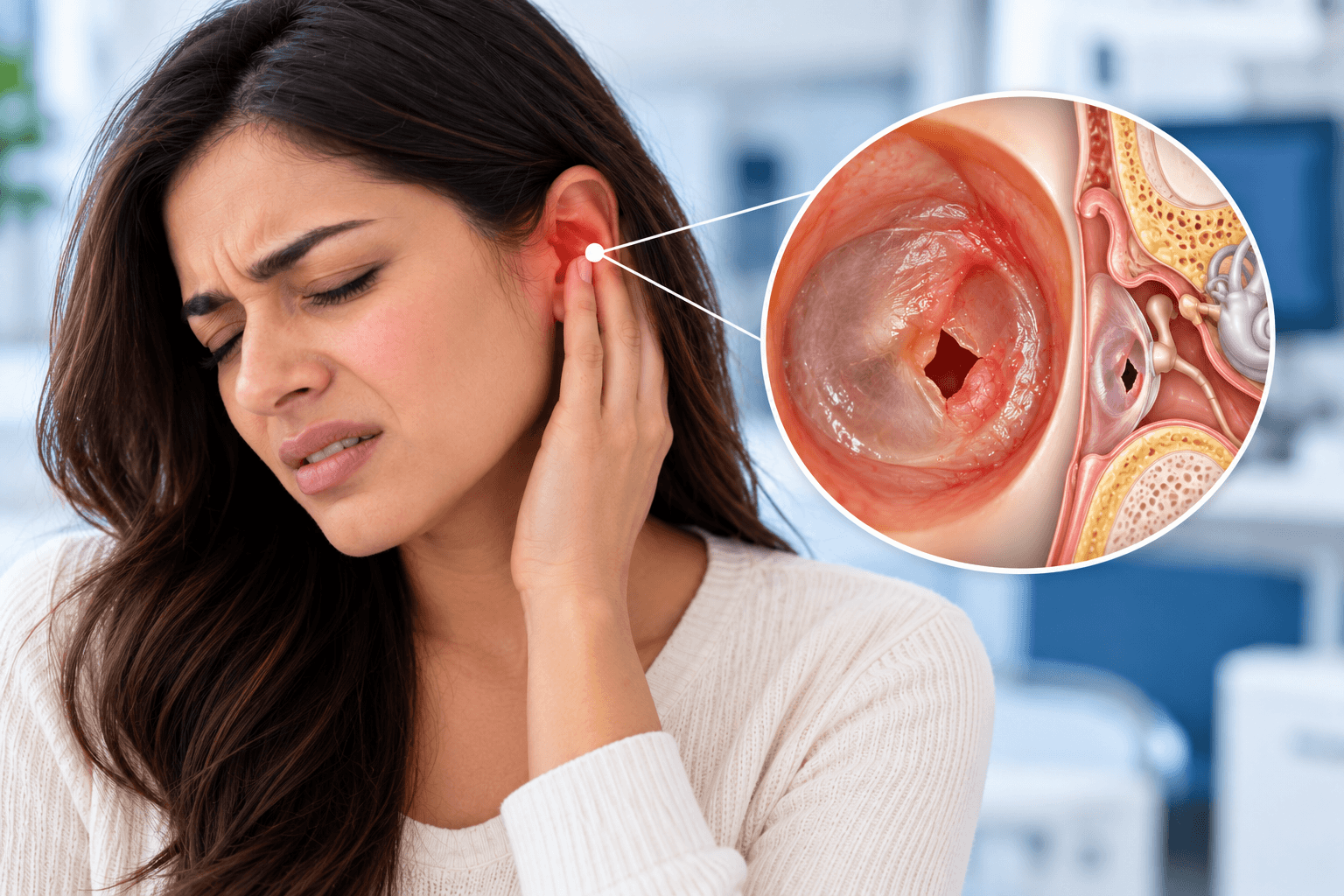
What Are the Signs of Perforated Eardrum and How it Can be Treated
A sudden sharp pain in the ear, a whistling sound when you blow your nose, or a bout of hearing loss after a beach dive can all point toward one deceptively small problem: a perforated eardrum. Although the tympanic membrane is only 0.1 mm thick, a tiny tear in it can have outsized effects on comfort, hearing, and infection risk. Understanding how to recognise the warning signs and how a modern ENT Clinic in Dubai can help the membrane heal will empower you to protect one of your most delicate senses.
What Exactly Is a Perforated Eardrum?
The eardrum (tympanic membrane) is a thin, semi-transparent barrier that separates the ear canal from the air-filled middle ear. It turns sound waves into mechanical vibrations that travel through the ossicles to the inner ear. When the membrane tears or develops a hole, sound transmission is disrupted and the middle ear is suddenly exposed to the outside world.
Small perforations (⩽ 2 mm) often heal on their own, but larger or infected tears can lead to chronic drainage, repeated otitis media or permanent hearing loss if untreated. Early evaluation by an ENT specialist in Dubai is therefore critical.

Key Signs and Symptoms to Watch For
Most patients realise something is wrong because the ear suddenly “feels different.” The exact presentation depends on the size and cause of the tear, but the checklist below covers the most common red flags:
| Symptom | Why It Occurs | Typical Onset |
| Sharp ear pain that quickly subsides | Sudden pressure release when the membrane ruptures | Seconds to minutes after trauma or loud blast |
| Muffled or reduced hearing | Loss of effective sound conduction | Immediate |
| Watery, bloody, or pus-filled discharge | Middle-ear fluid escapes through the hole | Hours to days |
| Tinnitus (ringing) | Abnormal air flow and turbulence | Immediate or delayed |
| Whistling sensation when sneezing/blowing nose | Air passes through perforation | Only during Valsalva manoeuvre |
| Dizziness or imbalance | Perilymph pressure changes, co-existing inner-ear irritation | Variable |
If you experience discharge with fever, severe vertigo or facial weakness seek urgent care. The perforation may be complicated by an aggressive infection or cholesteatoma.
How Does an Eardrum Tear in the First Place?
- Middle-ear infection (otitis media) - Fluid build up behind the drum raises pressure until it bursts. This is the leading cause in children.
- Sudden barometric changes - Rapid descent in an airplane, scuba diving or even an elevator can create a pressure differential the membrane cannot equalise.
- Direct trauma - Cotton buds, hairpins or an ill-timed slap can puncture the drum.
- Acoustic trauma - A fireworks blast or nearby gunshot delivers a pressure wave strong enough to rupture the membrane.
- Explosive events - Rare in daily life but possible in industrial accidents.
- Iatrogenic causes - Ear-cleaning syringes or ventilation tube insertion occasionally injure the membrane.
Healing Timeline: What the Research Says
For simple, infection-free perforations, multiple studies show spontaneous closure in 70-90 % of adults within six to eight weeks. Factors that slow healing include:
- Diameter greater than 4 mm
- Edge necrosis or rolled margins
- Persistent middle-ear infection
- Diabetes, smoking, or malnutrition
- Repeated water exposure (swimming, heavy showers)
Understanding these variables helps your ENT specialist decide whether conservative care is enough or if early surgical repair (myringoplasty) is wiser.
How ENT Specialists Diagnose a Perforation
At Ascent ENT Speciality Centre, a typical evaluation involves:
- Video otoscopy - High-definition imagery projected on a screen so you can see the tear yourself.
- Tympanometry - Measures eardrum mobility; a flat trace strongly suggests a perforation or fluid.
- Pure-tone audiogram - Quantifies any conductive or sensorineural hearing loss.
- Microbiological swab - If discharge is present, to target antibiotics accurately.
- CT scan (rare) - Reserved for chronic perforations with suspected cholesteatoma or ossicle damage.
Because several other conditions such as sudden sensorineural hearing loss or otitis externa can mimic the symptoms, these tests remove the guesswork and guide precise treatment.
First-Line Management: Let Nature Work-But Help It Along
Most recent, sterile perforations do not need immediate surgery. ENT doctor in Dubai will typically recommend:
- “Dry ear” precautions - No swimming. Use a Vaseline-coated cotton ball during showers.
- Topical antibiotic-steroid drops - Keep bacteria at bay and reduce inflammation.
- Oral analgesics - Paracetamol or ibuprofen for discomfort.
- Nasal decongestant spray - Improves Eustachian tube function and ventilation.
Never insert oil, garlic, or over-the-counter drops not prescribed for perforated drums; many are ototoxic once they reach the middle ear.
Paper-Patch Myringoplasty
If the edges look unhealthy or the hole is not shrinking after two weeks, the ENT doctor may freshen the margins and place a small gel-film or paper patch under topical anaesthesia. Success rates exceed 80 % for central perforations smaller than 5 mm.
Surgical Solutions for Persistent or Large Perforations
| Procedure | Typical Indications | Anaesthesia | Success Rate |
| Endoscopic myringoplasty | Central perforation ⩾ 5 mm, failure of paper patch | Day-case general | 85-90 % |
| Underlay tympanoplasty with cartilage graft | Marginal, subtotal, or retracted perforations; previous canal wall surgery | General | 90-95 % |
| Combined ossiculoplasty | Perforation plus ossicle erosion | General | Varies (70-85 %) |
Modern endoscopic techniques used at our Bur Dubai Operation theatre avoid external incisions, resulting in minimal scarring and faster recovery. Most patients go home the same day and can resume desk work within 48 hours.
What to Expect After Surgery
- Mild ear fullness or popping for two to three weeks
- Cotton wick removal after five to seven days
- Water precautions for three weeks until the graft is confirmed intact
- Follow-up audiogram at six to eight weeks to document hearing improvement
Special Considerations in Dubai’s Climate and Lifestyle
• Frequent swimmers and divers - Warm Gulf waters invite infection. Custom swim moulds can keep the canal dry while the drum heals.
• Air-conditioned environments - Low humidity dries ear canal skin, making it itchy. Resist scratching inside the canal.
• Desert sand and dust - Wear ear protection or rinse gently after off-road trips; foreign bodies can provoke infection and secondary perforation.
Preventing Future Eardrum Injuries
- Treat upper-respiratory infections promptly to avoid pressure build-up.
- Learn safe equalisation techniques before scuba training; never dive with congestion.
- Use noise-cancelling ear defenders at shooting ranges or construction sites.
- Retire the cotton bud your ear canal is self-cleaning.
Quick Myth Buster
“If I can’t hear well, forcing air up my nose will pop my ear open.” Wrong. Forceful Valsalva in the presence of nasal congestion can rupture the eardrum, and hence has to be avoided.
Why Choose Ascent ENT Speciality Centre for Perforated Eardrum Care?
- Experienced otologists and neuro-otologists
- Advanced diagnostics on-site – Video otoscopy, impedance audiometry, and high-frequency audiograms under one roof.
- Microscopic and endoscopic repair options
- Integrated audiology and balance clinic
- Multilingual team - English, Arabic, Malayalam, Hindi spoken ensuring clear communication with expatriate families.
Take the Next Step Toward Clearer, Safer Hearing
A perforated eardrum can turn a routine swim or flight into weeks of discomfort but it doesn’t have to. Whether you need reassurance, conservative care or state-of-the-art surgical repair, the ENT specialists at Ascent ENT Dubai are ready to help. Book your appointment to secure a same day slot at our clinic. Your ears deserve expert attention. Let’s restore your hearing together.