
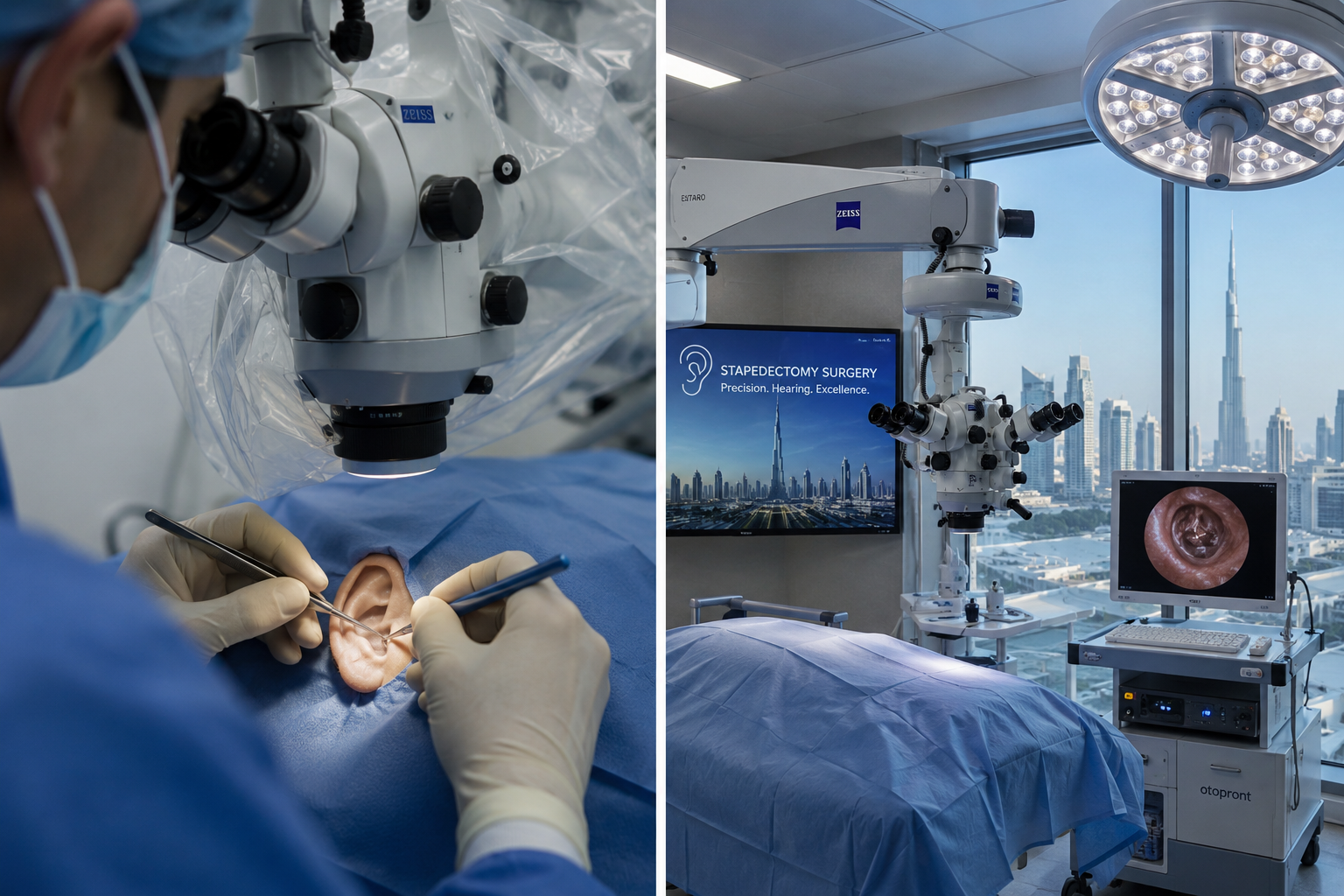
Hearing loss that creeps up slowly in one or both ears is one of those things people ignore for way too long. And honestly, a lot of the time it comes down to something called otosclerosis -where the stapes bone in your middle ear gradually stiffens up and stops doing its job. That little bone is supposed to vibrate and pass sound through. When it can't move anymore, the sound just... doesn't get through properly. Stapedectomy is the surgery that fixes this. It's a microsurgical procedure where the stiff bone gets replaced with a tiny prosthesis that takes over that job.
At Ascent ENT Speciality Centre in Bur Dubai, the ear team handles this using both endoscopic and microscopic techniques, with all the hearing tests done in-house and proper follow-up care for patients coming in from across Dubai and the UAE.
So in simple terms - otosclerosis causes abnormal bone growth around the base of the stapes. The stapes is actually the smallest bone in the entire human body, which gives you a sense of how precise this surgery has to be. As that bone hardens and locks in place, sound can't reach the inner ear the way it should. Hearing fades. Sometimes tinnitus tags along for the ride too.
The surgery removes or works around that frozen bone and puts a prosthesis in its place to recreate the sound pathway. A lot of patients notice real improvement fairly quickly -and the tinnitus that came with the hearing loss? That often improves too, which surprises people.
Yes, and it confuses a lot of people. Both fix the same problem. Both use a prosthesis. The difference is in what happens to the footplate of the stapes:
Stapedectomy — part or all of the footplate gets removed before the prosthesis goes in.
Stapedotomy — instead of removing it, a tiny hole is made in the footplate (using microinstruments or a laser) and a piston-style prosthesis threads through it.
Honestly, that gets decided during the procedure itself based on what your ear anatomy actually looks like. If surgery isn't on the table for whatever reason -health, personal preference, whatever - hearing aids are a real option worth exploring too. The audiologists at Our best ENT clinic in Dubai can walk you through that comparison without pushing you either way.
Roughly speaking, you're probably in the right territory if:
If both ears are affected, the worse one gets treated first. The second ear comes later - your surgeon will tell you how long to wait between the two.
People often assume stapedectomy is some big involved surgery. It's really not - it's delicate, yes, but it goes through the ear canal with no external cuts and usually wraps up in under an hour as a day-case. You go home the same day in most cases.
Here's roughly how it goes:
| Step | Description |
|---|---|
| Anaesthesia | Local or general anaesthesia is used, depending on what is most appropriate for you. |
| Access | An endoscope or microscope is carefully inserted through the ear canal to reach the middle ear. |
| Check | The eardrum is gently lifted so the surgeon can clearly examine the hearing bones. |
| Stapes Procedure | The fixed stapes bone is either removed or a precise opening is created in the footplate. |
| Prosthesis Placement | A titanium prosthesis is inserted to restore the natural transmission of sound. |
| Closure | The eardrum is repositioned, and light packing is placed in the ear canal to support healing. |
That's it. Under an hour, no visible cuts, home same day.
This is probably what people worry about most. The short answer is: it's manageable.
| Stage | What's going on |
| Day of surgery | Home the same day usually. Mild dizziness or a blocked-up feeling is totally normal |
| Week 1 | Keep the ear dry, don't blow your nose hard, light activity is fine |
| Weeks 2-3 | No flying, no swimming, nothing too strenuous. First follow-up happens around here |
| Weeks 4-6 | Hearing starts noticeably improving. A repeat hearing test checks how things are going |
The muffled feeling in the first week or two isn't your hearing getting worse - it's just the internal packing doing its thing. It dissolves on its own. The mild dizziness and occasional popping are normal too and settle down as everything heals.
Flying is the one people ask about most, especially in Dubai where half the population seems to be on a plane every other week. Wait around three weeks, or until your surgeon gives you the green light at your follow-up. Cabin pressure is rough on a healing ear.
Stapedectomy has genuinely good success rates - it's one of the more reliable procedures in ear surgery. Most people get meaningful hearing improvement. But complications do exist and it's worth knowing about them going in. Temporary dizziness, some taste disturbance, tinnitus shifts, and in rare cases further hearing loss - these are the ones that come up. The team here takes patient selection seriously precisely because risk reduction starts well before you get to the operating table.
As for how long it lasts - the prosthesis is meant to be permanent. Most people are done and dusted, with long-lasting results, and only a small fraction ever need revision surgery.
There's no single number that covers everyone because the cost depends on a few things - which technique is used, the type of prosthesis, anaesthesia, facility fees, and what follow-up care is included. At your consultation the team puts together a clear estimate based on your specific situation. If you're going through insurance, they can also guide you on what documents are usually needed to get pre-approval sorted.
There are a few ENT centres in Dubai. What Ascent brings specifically:
| Feature | Description |
|---|---|
| Specialist Otology Team | Experienced surgeons focused specifically on middle ear conditions, not general ENT practice. |
| Comprehensive In-House Diagnostics | Audiometry, tympanometry, and speech testing are all available on-site without external referrals. |
| Endoscopic & Microscopic Techniques | We use both endoscopic and microscopic approaches, selecting the technique best suited to your condition. |
| Day-Case Surgery | Most procedures are performed as day-case surgeries, allowing you to return home the same day with detailed aftercare instructions. |
| International Patient Coordination | Dedicated support for both UAE residents and international patients travelling for treatment. |
| Structured Follow-Up | Regular hearing assessments and follow-up appointments help monitor your recovery and long-term results. |
If hearing loss has been quietly affecting your work, your conversations, or just your day-to-day confidence - it's worth getting it checked properly. The team at Ascent ENT Speciality Centre in Bur Dubai can assess whether stapedectomy makes sense for your specific situation. Book your consultation and get a straight answer.
